Scaling Agricultural Solutions and Strengthening Food Systems at UNGA81
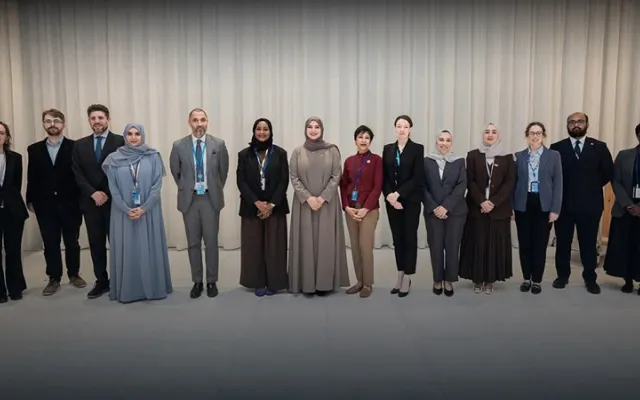
ICBA highlighted the policies, capacity and financing needed to turn proven agricultural solutions into national-scale programmes at the 81st session of the United Nations General Assembly in New York. Its participation formed part of the Ministry of Climate Change and Environment (MOCCAE) delegation in two ministerial dialogues chaired by H.E. Dr. Amna bint Abdullah Al Dahak, Minister of Climate Change and Environment.
Dr. Tarifa Alzaabi, Director General of ICBA, emphasised designing for scale from the outset during the water-secure agriculture dialogue. She also moderated discussions on strengthening food systems and critical supply chains through early risk preparedness, diversified supply sources and better data sharing. Together, these contributions brought ICBA’s expertise into discussions on the practical requirements for wider adoption and resilience.
Accelerator Graduates Showcase 25 Agribusiness Concepts in Nukus, Uzbekistan
Participants in ICBA’s Farmers’ and Agro-Entrepreneurs Accelerator marked their graduation in Nukus, Uzbekistan, by presenting 25 agribusiness concepts, with ten recognised for their potential. Their ideas used climate-resilient crops introduced by ICBA to develop food and feed products and soil amendments.
The programme engaged 207 participants, nearly 59% of them women, combining agricultural knowledge with business skills and market opportunities. Supported by the Abu Dhabi Fund for Development (ADFD), it was implemented by ICBA in partnership with Uzbekistan’s Agency for Innovative Development to help participants turn locally grown crops into value-added products and viable enterprises.
Sharing Research Priorities with AIRCA Members in Kigali
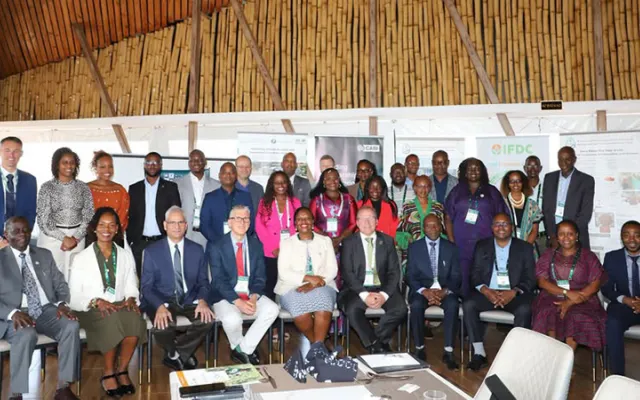
ICBA brought its experience in resource-efficient agriculture in arid and saline environments to the meeting of the Association of International Research and Development Centers for Agriculture (AIRCA) in Kigali, Rwanda.
Dr. Ganga Rao Nadigatla, Chief Scientist, presented the Center’s latest research, projects and research-for-development initiatives, focusing on practical agricultural systems that respond to stakeholder needs and withstand challenging conditions.
As a founding member of the six-center association, ICBA contributes specialised expertise to a network that combines complementary research capabilities to address agricultural development challenges.
New Research Chair to Advance Emirati Women’s Leadership in Agricultural Research
ICBA launched a research chair in sustainable and resilient agriculture as part of the month-long recognition of Emirati Women’s Day. The two-year opportunity will enable an outstanding Emirati woman researcher to lead multidisciplinary studies addressing food security, sustainable resource management and farmers’ needs.
The researcher will have access to the Center’s scientific expertise, facilities and partnerships to translate findings into practical solutions. ICBA intends to open applications in January 2027, with details to follow.
Agricultural Innovation for Food Security at Hili Forum 2026
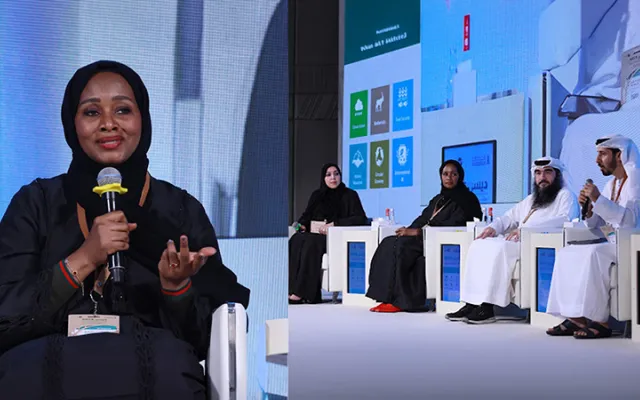
Turning agricultural research into solutions for farms and value chains was central to ICBA’s contribution to the third Hili Forum in Abu Dhabi, organised by the Emirates Center for Strategic Studies and Research (ECSSR) and the Anwar Gargash Diplomatic Academy (AGDA).
Speaking during the food security session, Dr. Tarifa Alzaabi, Director General of ICBA, highlighted how research and innovation can strengthen resilience in arid and saline environments. She shared ICBA’s experience in translating research into agricultural practice and developing crops adapted to challenging conditions, underscoring the importance of connecting scientific advances with farmers’ needs.
Water Efficiency and Salinity Management Solutions at Dubai Environment Conference
Improving water-use efficiency, managing salinity and advancing climate-smart crops were central to ICBA’s contribution to the Dubai Environment Conference and Exhibition 2026, organised by the Dubai Environment and Climate Change Authority under the theme “Protecting Our Environment, Securing Our Future.”
Dr. Tarifa Alzaabi, Director General of ICBA, participated in the panel “Food Security: The Intersection of Environmental Sustainability and Community Resilience”. She highlighted how ICBA’s science-based solutions address agricultural challenges in arid and saline environments, supporting more sustainable food production while protecting the natural resources on which communities depend.
Exploring Food Security Opportunities for Emirati Women Entrepreneurs
Research and innovation can open new opportunities for Emirati women entrepreneurs across food, water and climate. This was the focus of ICBA’s contribution to the 1st National Economic Forum for Emirati Women 2026 in Umm Al Quwain, held under the patronage of H.H. Sheikha Sumaya bint Saqr Al Qasimi, wife of H.H. the Ruler of Umm Al Quwain.
Speaking on “Food Security and New Economic Opportunities”, Dr. Tarifa Alzaabi, Director General of ICBA, discussed how agricultural challenges can inspire new solutions and business models, strengthening women’s participation in these sectors. The forum marked Emirati Women’s Day under the theme “We Emerge Stronger and Better”.
22 Women Build Skills in Agricultural Value Chain Development in Tashkent
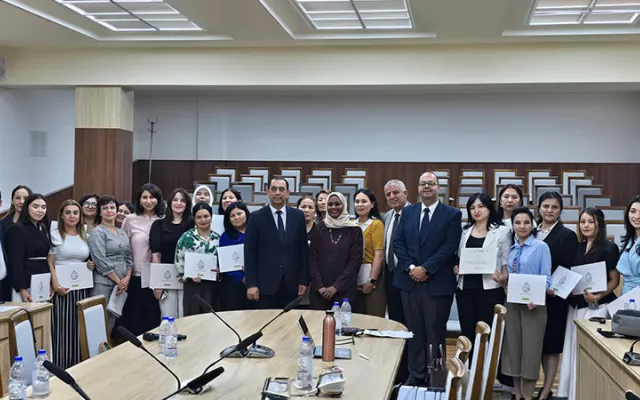
Twenty-two women from Central Asia and Azerbaijan explored how to increase the commercial value of agricultural products during ICBA’s practical workshop in collaboration with Tashkent State Agrarian University.
Training covered expanding production, developing products that meet market demand, reducing and reusing agricultural waste, and improving market access. These skills can help participants develop viable enterprises around climate-resilient agriculture and identify new income opportunities.
The workshop formed part of ICBA’s capacity-development cooperation with the Islamic Development Bank (IsDB), supporting wider adoption of agricultural solutions among farmers, entrepreneurs and their communities.
New Knowledge Exchange Program Links Training in Dubai with Field Application in Uzbekistan
ICBA launched its Knowledge and Training Exchange Program for Agricultural Sustainability, with ten specialists from Uzbekistan in its first cohort. The programme connects practical training with field application, building local expertise to use proven agricultural practices and support their wider adoption.
Participants received training in integrated fish and crop production in Dubai from 21–23 September. The second phase took place on 5–6 October in Nukus, where laboratory sessions and field activities gave 16 participants practical experience in operating integrated systems combining aquaculture, crop production and spirulina cultivation. Funded by the Abu Dhabi Fund for Development (ADFD) as part of the Karakalpakstan project’s scale-up phase, the programme prepared specialists to adapt these systems to local conditions and expand their use.
141 Farmers in Uzbekistan Build Skills for Agriculture in Saline and Water-Scarce Conditions
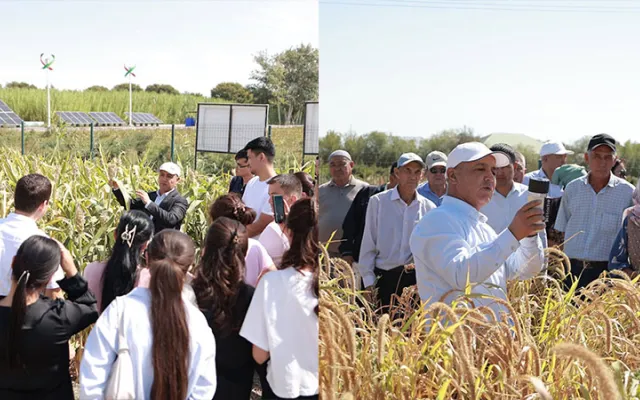
From crop selection to market access, ICBA’s Farmer Field Schools in Nukus and Chimbay gave 141 farmers, including 55 women, practical training across the agricultural production cycle.
At the Center’s demonstration sites, participants learned about salt-tolerant crops, cultivation practices, harvesting, seed storage, packaging and ways to add value to their produce.
Funded by the Abu Dhabi Fund for Development (ADFD) under the Karakalpakstan Project’s scale-up phase, the schools prepared farmers to apply these practices in their own fields and make better use of their harvests.
Climate-Smart Irrigation in Focus at Islamabad Carbon Markets Dialogue
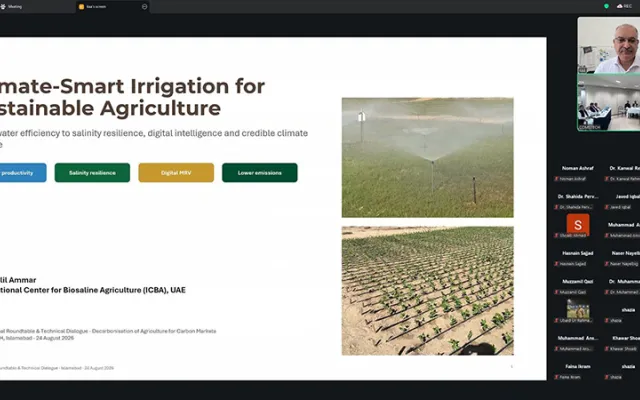
Improving water productivity and reducing irrigation-related emissions were the focus of ICBA’s contribution to the International Roundtable and Technical Dialogue on “Decarbonisation of Agriculture for Carbon Markets” in Islamabad, Pakistan.
Representing the Center, Dr. Khalil Ammar, Senior Scientist, presented “Climate-Smart Irrigation for Sustainable Agriculture”, examining approaches to managing salinity, digital monitoring and lower-emission irrigation. His contribution connected water management with the wider discussion on nature-based solutions, sustainable agriculture and the potential of carbon markets to benefit smallholder farmers.