ICBA and AOAD sign MoU and launch regional workshop on “Building Climate-Resilient Food Systems in the Arab Region”
The workshop focuses on advancing the sustainable production of quinoa, sorghum and millet, exchanging expertise and national experiences, and identifying agricultural priorities, gaps and needs in the target countries. These discussions will inform a roadmap for a regional project to expand the adoption of these crops and develop their value chains, contributing to more diversified agricultural production, improved farmers’ livelihoods and stronger food security.
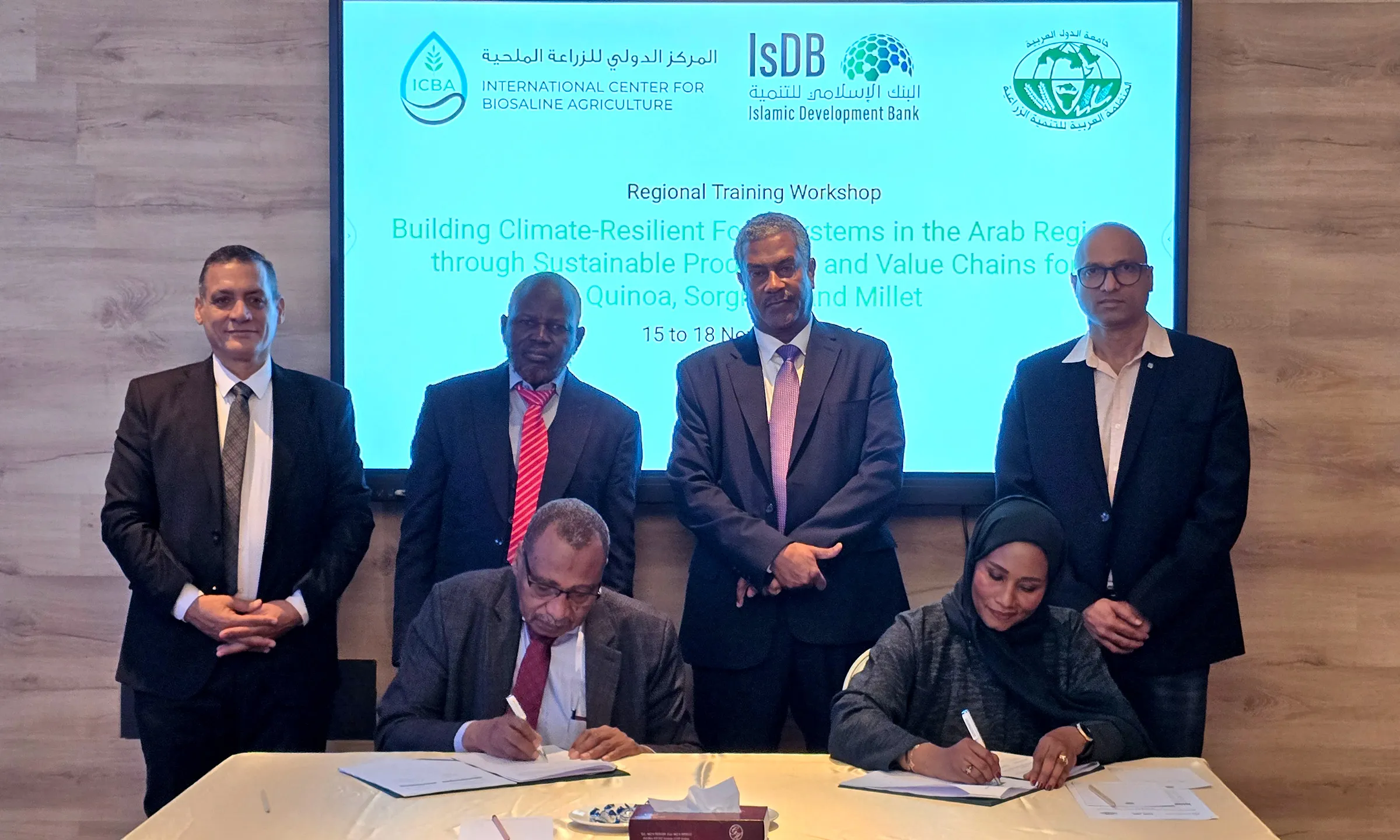
The MoU was signed by Dr. Tarifa Ajeif Alzaabi, Director General of ICBA, and H.E. Prof. Ibrahim Adam Ahmed El-Dukheri, Director General of AOAD.
The International Center for Biosaline Agriculture (ICBA) and the Arab Organization for Agricultural Development (AOAD) have signed a Memorandum of Understanding (MoU) in Amman, Jordan, establishing a five-year strategic partnership to advance scientific research, agricultural innovation, capacity development and sustainable natural resource management. The partnership aims to support food and water security and strengthen the capacity of agricultural systems across the Arab region to adapt to climate change.
The MoU was signed by Dr. Tarifa Ajeif Alzaabi, Director General of ICBA, and H.E. Prof. Ibrahim Adam Ahmed El-Dukheri, Director General of AOAD.
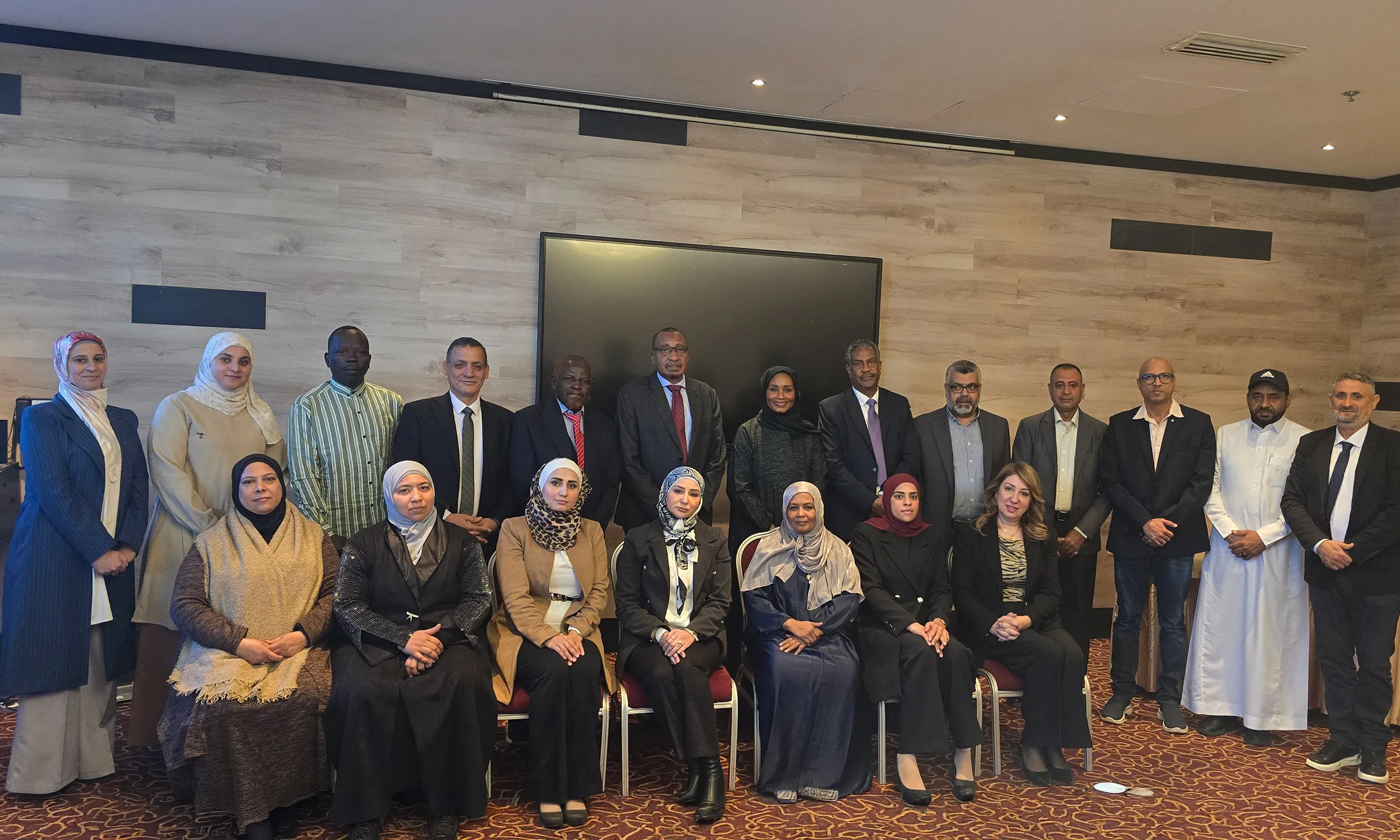
Following the signing, the two organizations launched the regional workshop “Building Climate-Resilient Food Systems in the Arab Region” as a practical step towards implementing the partnership and translating its objectives into action. Taking place from 15 to 18 November 2026, the workshop targets agricultural specialists from six Arab countries: Jordan, Sudan, Egypt, Lebanon, Saudi Arabia and Syria.
The workshop focuses on advancing the sustainable production of quinoa, sorghum and millet, exchanging expertise and national experiences, and identifying agricultural priorities, gaps and needs in the target countries. These discussions will inform a roadmap for a regional project to expand the adoption of these crops and develop their value chains, contributing to more diversified agricultural production, improved farmers’ livelihoods and stronger food security.
The workshop is being implemented within the framework of technical assistance provided by the Islamic Development Bank (IsDB) to ICBA to scale up sustainable agricultural solutions and increase their development impact.
A partnership to advance research and scale up agricultural solutions
The MoU combines ICBA’s expertise in developing crops adapted to arid and saline environments and sustainably managing water and soil resources with AOAD’s role in supporting agricultural development and strengthening cooperation and integration among Arab countries.
The partnership aims to develop joint research and applied programmes that address the region’s agricultural challenges, particularly water scarcity, soil salinity, land degradation and climate change, with an emphasis on translating scientific knowledge into practical, scalable solutions.
Areas of cooperation include developing food and forage crops that tolerate environmental stresses, improving water-use efficiency, using non-conventional water resources—including treated wastewater, greywater and saline groundwater—and rehabilitating degraded agricultural land.
The partnership also encompasses applications of artificial intelligence, biotechnology and smart agricultural technologies, joint research, training programmes for farmers and agricultural extension professionals, and the exchange of expertise and knowledge among relevant institutions.
Dr. Tarifa Ajeif Alzaabi, Director General of ICBA, said: “Over the years, ICBA has developed and evaluated crops adapted to arid and saline environments, building the scientific knowledge and expertise needed to diversify agricultural production and improve the efficiency of natural resource use. Our focus on three crops—quinoa, sorghum and millet—draws on our research and practical experience and reflects the promising opportunities these crops offer to strengthen food security in the Arab region.”
Dr. Tarifa Ajeif Alzaabi added: “Through our partnership with AOAD, we seek to move from developing solutions and demonstrating their viability to scaling up their application and adoption across the region. This means addressing the actual gaps and needs of the target countries, whether in providing suitable seeds, improving agricultural practices, building capacities, strengthening value chains or facilitating market access. Our goal extends beyond increasing production to building an integrated system that ensures scientific solutions reach farmers and translate into sustainable economic opportunities that support livelihoods and food security.”
H.E. Prof. Ibrahim Adam Ahmed El-Dukheri, Director General of AOAD, said: “What distinguishes this proposed regional project is its integrated approach, which extends beyond increasing agricultural production to connect scientific research and technological development with improved seed production systems, climate-smart agricultural practices, capacity development, value chain development, agro-processing and marketing.”
From capacity development to a regional roadmap
The regional workshop represents an initial practical step in implementing the new cooperation framework. It brings together specialists from the target countries to exchange knowledge and expertise on the sustainable production of quinoa, sorghum and millet as promising crops for diversifying agricultural and food production amid climate challenges and resource scarcity.
The programme combines technical training, practical applications and discussions on national priorities to identify opportunities for crop adoption and value chain development, while connecting scientific research with the needs of farmers and markets.
Dr. Srinivasan Samineni of ICBA is delivering sessions on quinoa and millet improvement programmes, sustainable production of the target crops, quinoa processing and value chain development. Dr. Adil Abdelrahim of AOAD is addressing improvements in crop tolerance to environmental stresses, good agricultural practices for sorghum and millet, market opportunities and private-sector engagement.
The programme includes working groups to assess crop suitability under the agricultural and environmental conditions of the target countries, discuss implementation sites and develop a proposed three-year regional framework. It also includes a field visit to explore agricultural research and its practical applications in Jordan.
The workshop’s outcomes are expected to help define the proposed regional project’s components, priorities and mechanisms for cooperation in its implementation, in accordance with the technical, institutional and financing arrangements to be agreed.