ICBA spotlights women’s leadership and water resilience at Tashkent Water Week 2026
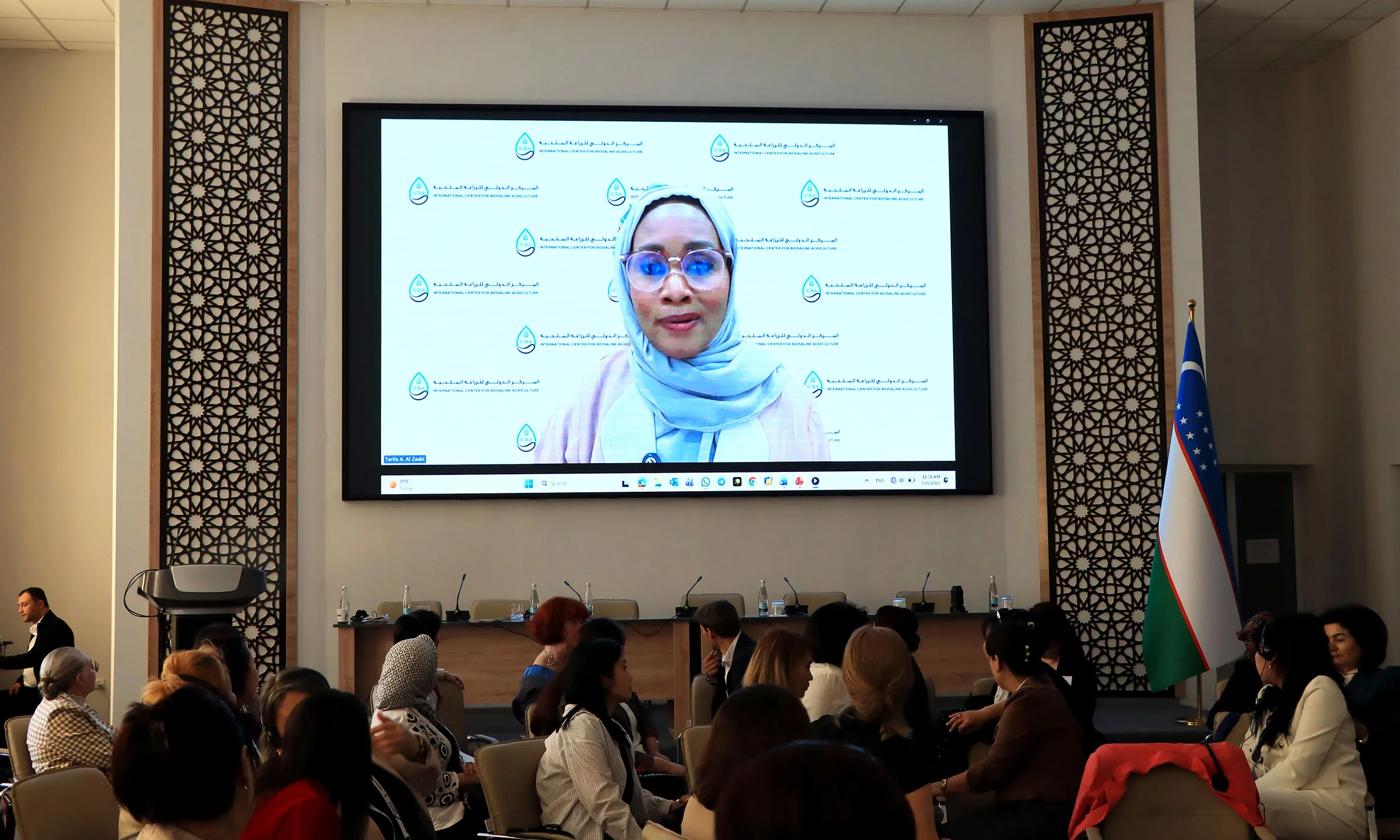
Through its participation in Tashkent Water Week 2026 and Women Water Week, ICBA reinforced the importance of connecting science, leadership, policy dialogue, and cooperation in support of more resilient water and agricultural systems.
The International Center for Biosaline Agriculture (ICBA) took part in Tashkent Water Week 2026, held on 25-26 March in the Uzbek capital under the theme “Technologies and Innovations in Water Management. Central Asia in the Global Water Cycle”, bringing together policymakers, technical experts, development institutions, and international partners, with more than 85 speakers in attendance, to advance dialogue on water management, innovation, and sustainable development.
ICBA also took part as a key partner in Women Water Week: “From Knowledge to Practice”, a two-day platform focused on leadership, policy dialogue, and professional exchange across the water sector, which brought together 80 participants. As part of this platform, Dr. Tarifa Al Zaabi, Director General of ICBA, participated virtually in Session 4: “Leadership Skills,” a session dedicated to the exchange of knowledge and experience among women leaders. The session was moderated by Barbara Janusz-Pawletta, Regional Representative for Central Asia at the International Water Management Institute (IWMI), and brought together senior female representatives from international organizations, relevant national entities, and regional platforms.
In her virtual remarks, Dr. Tarifa emphasized the importance of combining science-based innovation, practical cooperation, and strong leadership to address increasingly complex water challenges. She stressed that water security and agricultural resilience in dryland regions depend on stronger links between technical knowledge, local realities, and sustained collaboration across sectors, while underscoring the central role of women in shaping and advancing sustainable solutions.
At an important moment for Uzbekistan’s water sector, Tashkent Water Week provided a timely platform for dialogue, innovation, and regional cooperation. ICBA’s participation was closely aligned with these priorities and also reflected its broader presence in Uzbekistan through its project, “Development of Sustainable Agricultural Production Systems in Degraded Areas of Karakalpakstan”, and related efforts in sustainable agriculture, water and land management, and resilience-building in areas facing growing environmental pressures. These efforts have helped ICBA reach more than 900 women, and the center aims to deepen and expand this impact further in the next phase, including across Central Asia.
Held during Women’s History Month, the session added further relevance to the programme by spotlighting the growing importance of women’s leadership in shaping practical, knowledge-based responses to water challenges.
Dr. Tarifa Al Zaabi, Director General of ICBA, said: “Water security and agricultural resilience in dryland regions depend increasingly on our collective ability to combine science-based innovation, effective leadership, and practical action. Platforms such as Tashkent Water Week matter because they bring together policy, technical knowledge, and regional cooperation at a time when water challenges are becoming more complex and interconnected. Women must be fully recognized as essential partners in shaping and advancing the solutions needed for more resilient water and food systems.”
Barbara Janusz-Pawletta, Regional Representative for Central Asia, IWMI, said: “Women Water Week provided an important platform for dialogue, leadership exchange, and practical engagement across the water sector. ICBA’s partnership in this platform reflects the value of collaboration between research and development institutions in advancing more informed and resilient responses to water challenges. Partnerships such as that between IWMI and ICBA strengthen the exchange of knowledge, experience, and applied perspectives needed to support sustainable water and agricultural systems in the region.”
Through its participation in Tashkent Water Week 2026 and Women Water Week, ICBA reinforced the importance of connecting science, leadership, policy dialogue, and cooperation in support of more resilient water and agricultural systems.